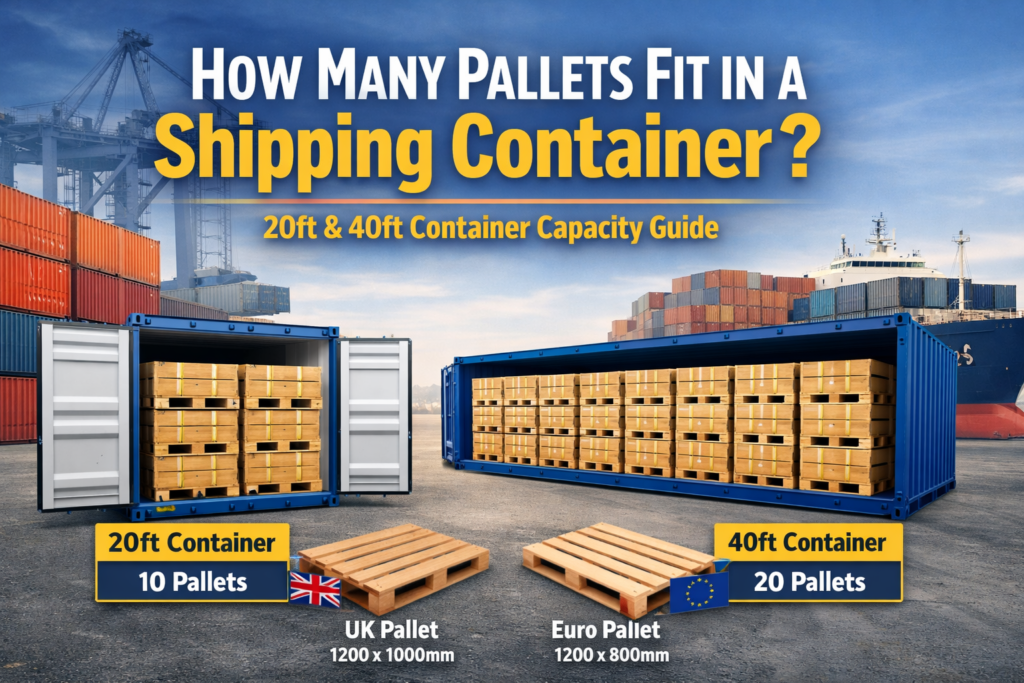
Quick answer: a standard 20ft shipping container fits 10 UK pallets or 11 Euro pallets in an optimised single layer. A standard 40ft shipping container fits 21 UK pallets or 25 Euro pallets. Actual usable capacity can be lower when loads overhang, handling clearance is required or internal dimensions differ.
Pallet count converts floor area into a practical storage measure. The capacities below use representative dry-container dimensions and standard 1,200 × 1,000mm UK and 1,200 × 800mm Euro pallet footprints.
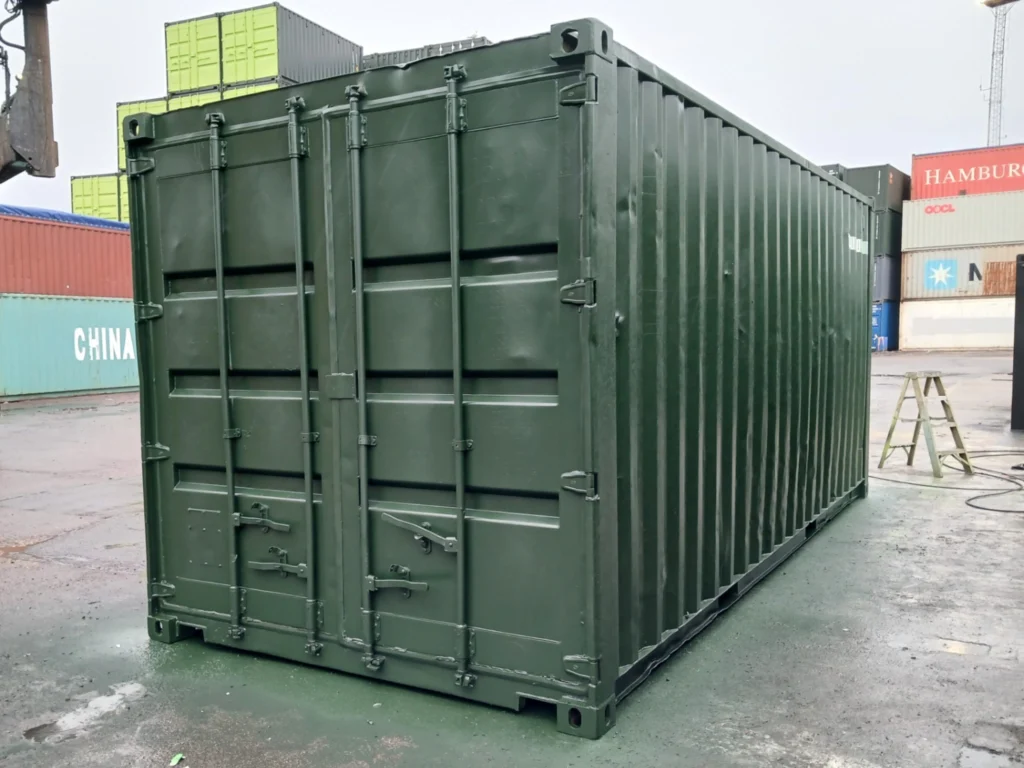
Quick Reference: Pallet Capacity by Container Size
The table below shows single-layer pallet capacity for all common UK container sizes.
| Container Size | Internal Floor Area | UK Pallets (1,200 x 1,000mm) | Euro Pallets (1,200 x 800mm) |
|---|---|---|---|
| 10ft Standard | ~7.0 m² | 5 pallets | 6 pallets |
| 20ft Standard | ~13.9 m² | 10 pallets | 11 pallets |
| 40ft Standard | ~28.3 m² | 21 pallets | 25 pallets |
| 40ft High Cube | ~28.3 m² | 21 pallets (single layer) | 25 pallets (single layer) |
Important: these are optimised single-layer layout capacities. Pallet overhang, wrapping, dunnage, door clearance and the equipment used to position pallets can reduce the practical total.
Capacity reference: Kuehne+Nagel’s container placement guide shows 10 UK/industrial and 11 Euro pallets in a 20ft container, and 21 UK/industrial and 25 Euro pallets in a 40ft container. Pallet dimensions are supported by CHEP’s UK pallet specification and the EPAL Euro pallet specification.
Need the right container for your pallet count? Tell us the pallet type, quantity and delivery postcode for a delivered container quote.
For Euro-pallet loading patterns, see our dedicated Euro pallet guide. For the dimensional differences, see UK vs Euro pallet sizes.
What Affects How Many Pallets Fit?
The theoretical pallet count is a starting point. In practice, several factors can reduce or occasionally increase the number of pallets that fit inside a given container.
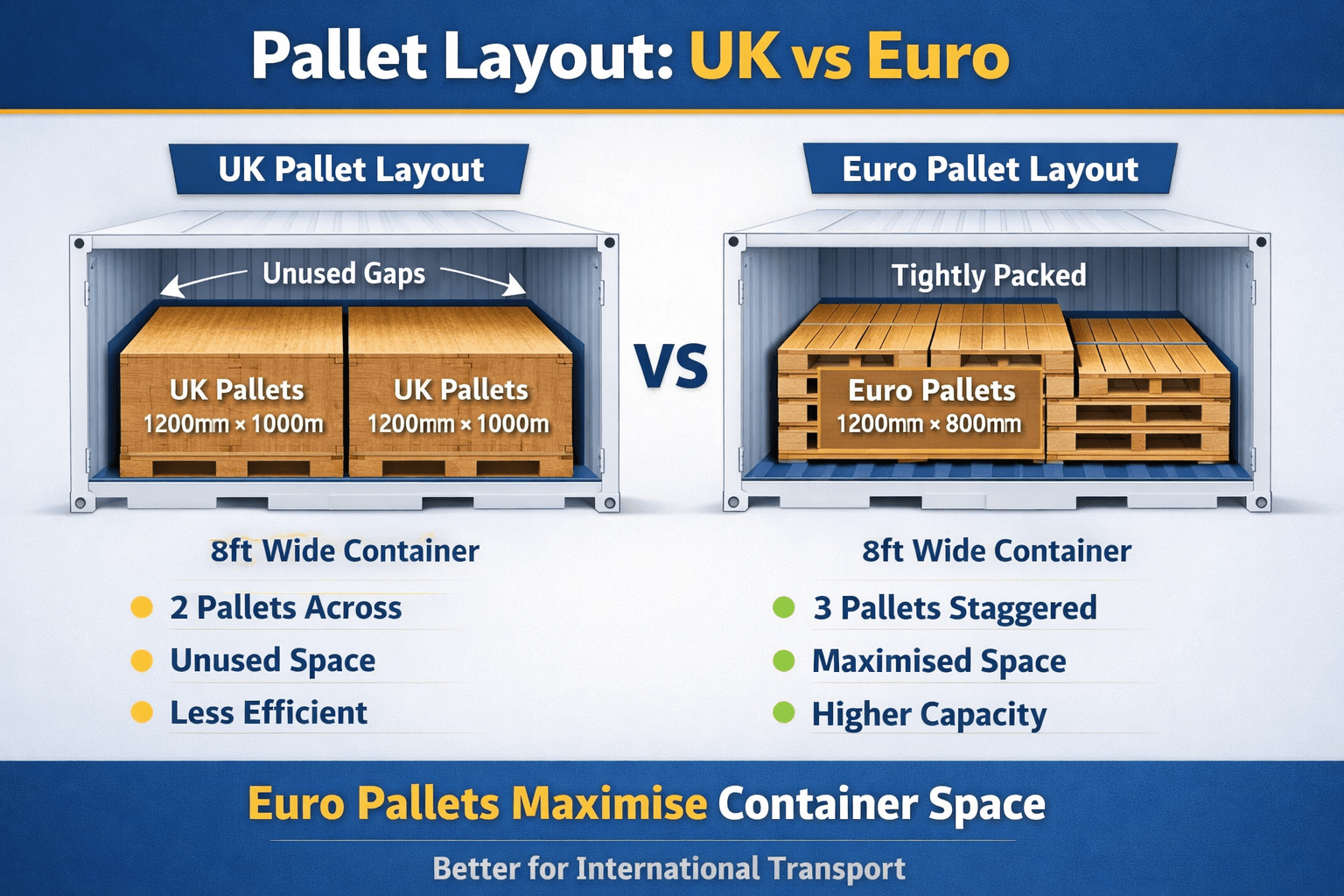
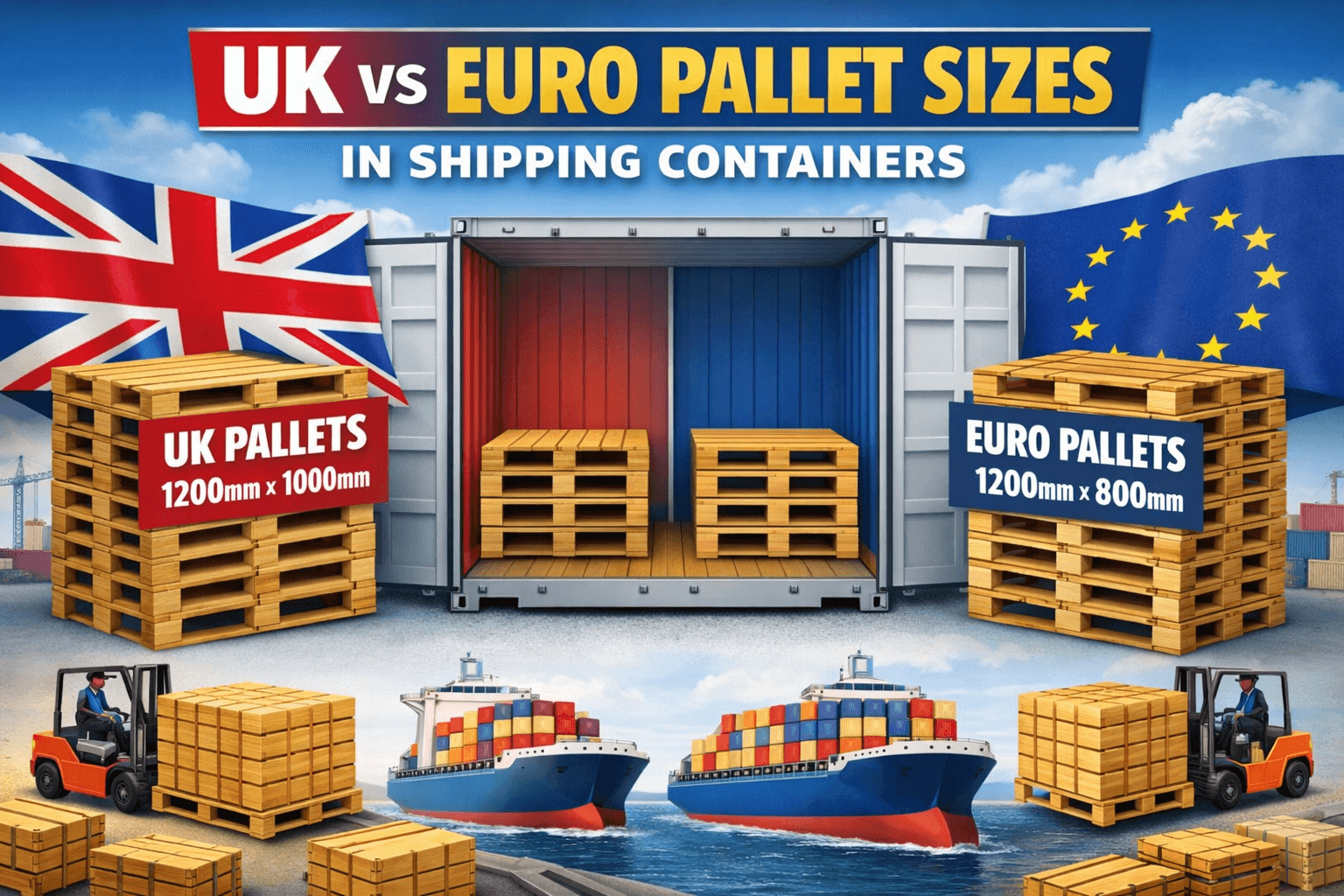
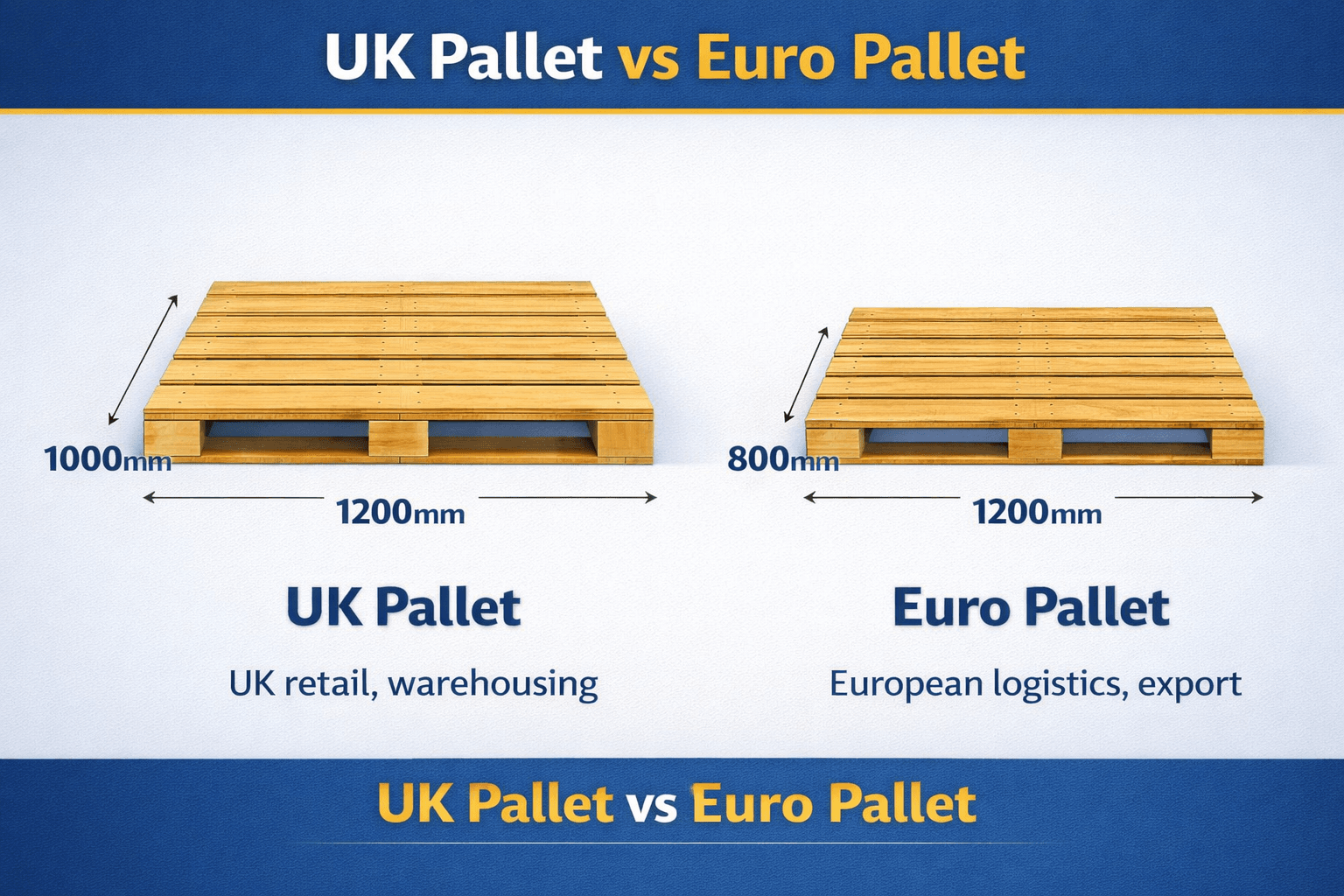
- Pallet size: UK standard pallets (1,200 x 1,000mm) take up more floor area than Euro pallets (1,200 x 800mm), fitting fewer per container
- Container internal dimensions: internal length, width and height are always smaller than external – always use internal measurements when calculating
- Door opening width: the internal width near the door frame is slightly restricted, which affects whether certain loading configurations actually work
- Cargo height: if pallets are loaded with tall goods, they cannot be double-stacked regardless of headroom
- Payload capacity: heavy goods can exceed the container’s maximum payload before the floor space runs out – see the weight limits section below
- Cross-members: the floor timber runs on steel cross-members, which can affect pallet placement near the door end
How Many Pallets Fit in a 20ft Container?
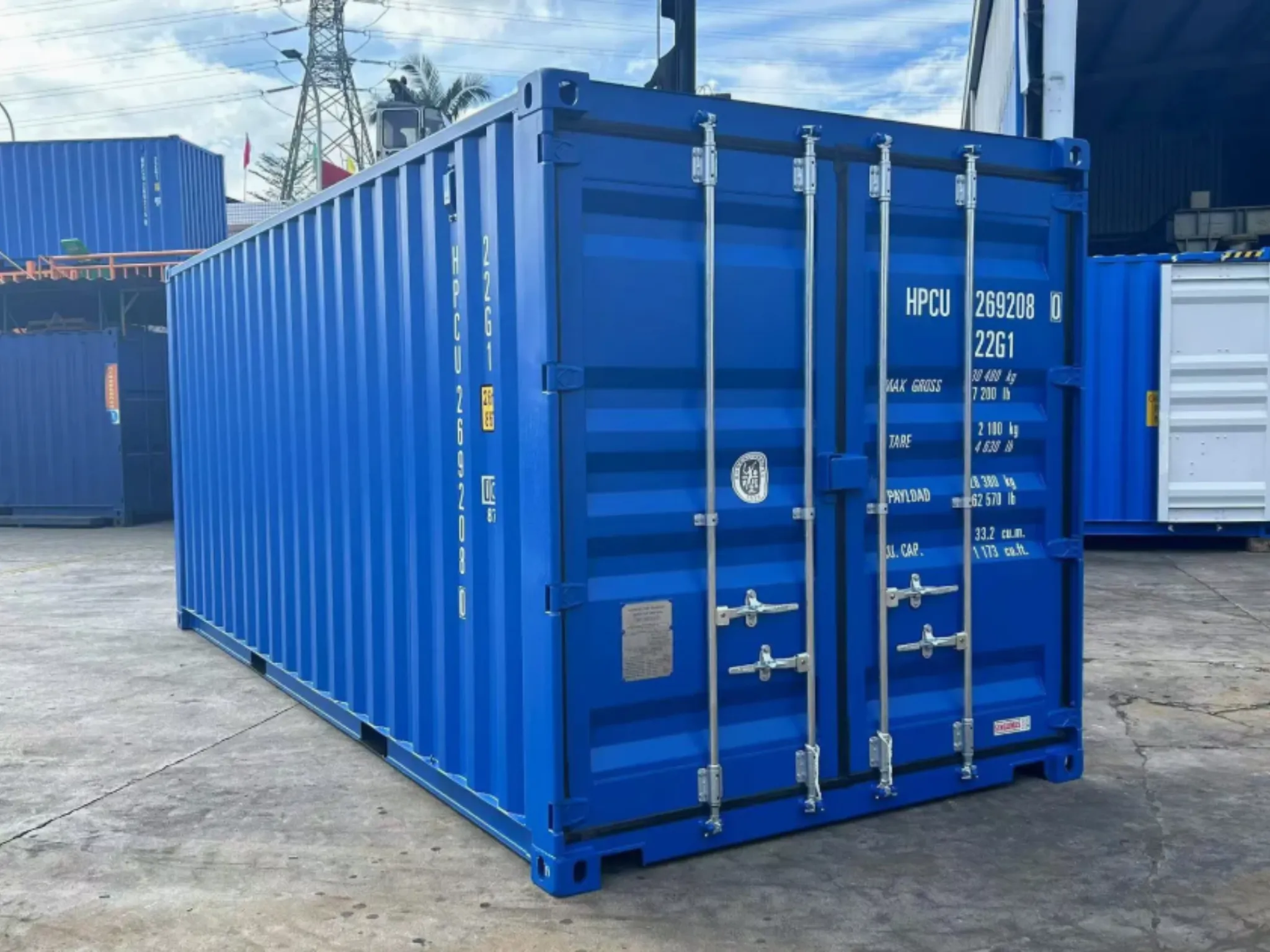
A standard 20ft shipping container has an internal length of approximately 5.9 metres and an internal width of 2.35 metres. This gives a usable floor area of around 13.9 m².
Standard UK pallets (1,200mm x 1,000mm) load in a pattern of two pallets across the container width and five rows along the length, giving a total of 10 pallets. Euro pallets (1,200mm x 800mm) fit slightly more efficiently, allowing 11 pallets in a single layer.
| Specification | Measurement |
|---|---|
| Internal length | 5.9 m (19ft 4in) |
| Internal width | 2.35 m (7ft 8in) |
| Internal height | 2.39 m (7ft 10in) |
| Internal volume | ~33 m³ |
| UK pallets (1,200 x 1,000mm) | 10 pallets |
| Euro pallets (1,200 x 800mm) | 11 pallets |
| Maximum payload | ~21,800 kg |
For most UK businesses storing palletised goods, a 20ft container provides enough floor space for a typical week’s stock rotation or overflow. The compact footprint also makes 20ft units easier to deliver to restricted sites. See our 20ft containers page for current pricing and availability.
How Many Pallets Fit in a 40ft Container?
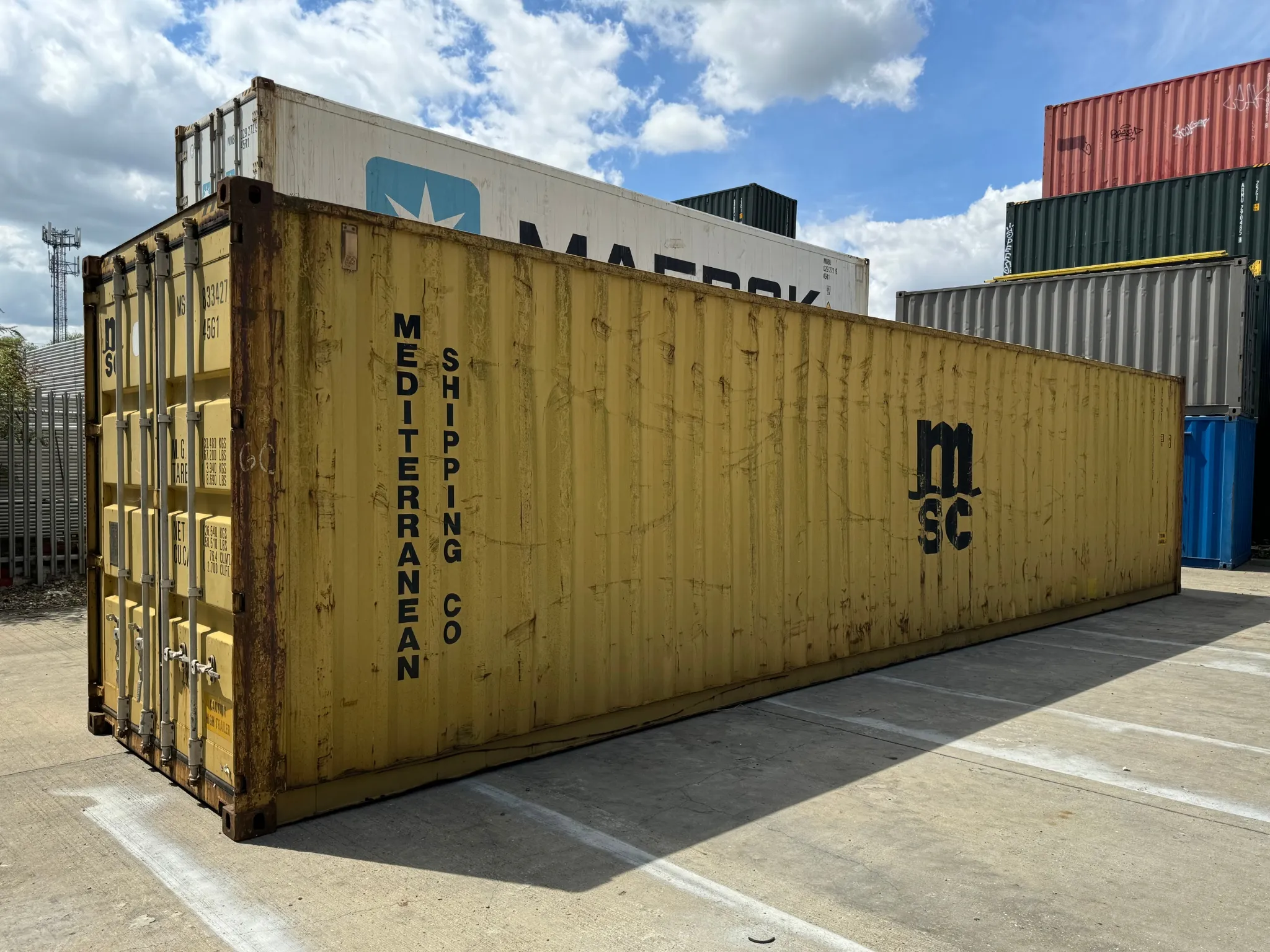
A standard 40ft shipping container has an internal length of approximately 12.03 metres – roughly double the 20ft unit. Internal width remains the same at 2.35 metres, giving a floor area of around 28.3 m².
With an optimised mixed-orientation layout, a 40ft container can fit 21 UK pallets in a single layer. The smaller Euro pallet footprint allows an optimised total of 25 Euro pallets. Straight-row loading or extra handling clearance may reduce the practical count.
| Specification | Measurement |
|---|---|
| Internal length | 12.03 m (39ft 5in) |
| Internal width | 2.35 m (7ft 8in) |
| Internal height | 2.39 m (7ft 10in) |
| Internal volume | ~67 m³ |
| UK pallets (1,200 x 1,000mm) | 21 pallets |
| Euro pallets (1,200 x 800mm) | 25 pallets |
| Maximum payload | ~26,730 kg |
A 40ft container is the most cost-effective option per pallet stored when comparing purchase price to storage capacity. For a full comparison of the two sizes, see our guide on 20ft vs 40ft Shipping Container: Which Size Should You Choose?
How Many Pallets Fit in a 10ft Container?
A 10ft shipping container has an internal length of approximately 2.8 metres and the same 2.35-metre internal width as larger units, giving a floor area of around 6.6 to 7.0 m².
In a single layer, a 10ft container fits approximately 5 UK standard pallets or 6 Euro pallets. The compact footprint makes 10ft units popular for very tight site access, garden storage, and small workshop setups where a full 20ft would not be practical.
High Cube Containers: Same Floor, More Height
A 40ft high cube container has the same floor area as a standard 40ft, so the optimised single-layer pallet count is identical: 21 UK pallets or 25 Euro pallets. The difference is internal height: the high cube measures 2.69 metres versus 2.39 metres for a standard unit – an extra 300mm of clearance.
This matters for two reasons. First, it accommodates taller palletised goods without the load catching the roof. Second, it makes double-stacking more practical when cargo height allows. A standard container’s 2.39m height leaves very limited headroom for two loaded pallet layers; the high cube’s extra 300mm gives meaningful additional flexibility for uniform goods.
For a full comparison, see our guide on High Cube vs Standard Containers: What’s the Difference?
Double Stacking Pallets: When It Works
Double stacking – placing one loaded pallet layer on top of another – can theoretically double storage efficiency. In practice it only works when all of the following conditions are met:
- Loaded pallet height is low: each layer must stand no taller than about 0.9 to 1.0m (including board) to fit two layers within a standard container’s 2.39m internal height
- Goods can bear weight above: rigid cartons (tins, bottles, hard packaging) can usually support a layer above; soft or fragile goods cannot
- Total weight stays within payload: doubling the pallet count doubles cargo weight – this must not exceed the container’s maximum payload limit
- High cube preferred: the extra 300mm in a high cube makes double-stacking goods of 1.0 to 1.1m per layer significantly more practical
For most UK storage users, double stacking is not practical for general mixed pallets. It works reliably for uniform, stackable goods in rigid packaging at consistent heights – tinned goods, dry foodstuffs, bottled goods, and similar.
Weight Limits vs Floor Space: Which Runs Out First?
This is the most commonly overlooked aspect of pallet planning. A container can physically run out of floor space before reaching its payload limit – or reach its weight limit before the floor is full. Which happens first depends entirely on how heavy your pallets are.
| Pallet Weight | 20ft (max payload ~21,800 kg) | 40ft (max payload ~26,730 kg) |
|---|---|---|
| 500 kg per pallet | Floor runs out first (10 pallets = 5,000 kg) | Floor runs out first (21 pallets = 10,500 kg) |
| 1,000 kg per pallet | Floor runs out first (10 pallets = 10,000 kg) | Floor runs out first (21 pallets = 21,000 kg) |
| 1,500 kg per pallet | Floor runs out first (10 pallets = 15,000 kg) | Weight limit first (~17 pallets = 25,500 kg) |
| 2,000 kg per pallet | Floor space and weight are both close (10 pallets = 20,000 kg) | Weight limit first (~13 pallets = 26,000 kg) |
For most palletised storage goods at 500 to 800 kg per pallet – retail stock, documents, light equipment – floor space is the binding constraint and standard pallet counts apply. For heavy goods such as machinery components, tiles, or dense materials, check the payload limit before assuming the container will fill to capacity. Full weight specs are in our guide on 40ft Shipping Container Weight: Tare, Payload and Gross. For the smaller size, use our 20ft shipping container weight guide.
Refrigerated Containers and Pallet Capacity
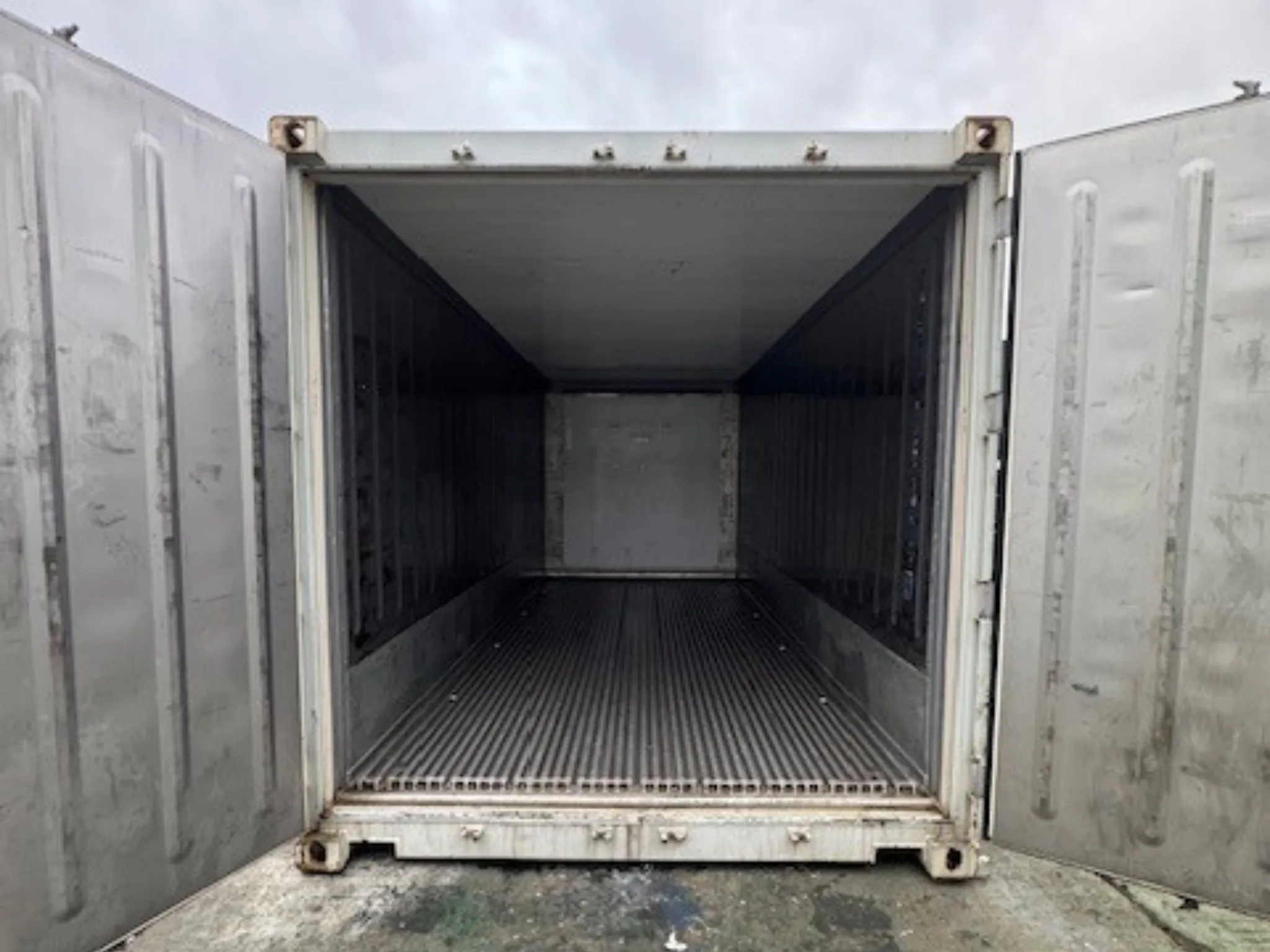
Refrigerated containers (reefers) have slightly smaller internal dimensions than standard dry containers of the same external size. Insulation panels on all walls reduce internal length and width by approximately 300 to 400mm per dimension.
A 20ft reefer typically fits 8 to 9 UK pallets rather than 10, and a 40ft reefer commonly fits approximately 18 to 20 UK pallets rather than the 21-pallet dry-container maximum. Exact figures vary by manufacturer, machinery arrangement and insulation specification. Always confirm the supplied unit’s internal dimensions.
Practical Loading Tips to Maximise Pallet Capacity
- Load from the back: fill from the far end towards the doors, keeping each row tight before starting the next
- Use Euro pallets where appropriate: the optimised layout fits one additional pallet in a 20ft container and four additional pallets in a 40ft container
- Test pallet orientation on paper: in some configurations rotating pallets 90° makes better use of container width
- Block and brace any gaps: a loose pallet can shift during transport – fill voids with dunnage or void fillers
- Calculate total cargo weight first: confirm total weight is within payload before booking delivery
- Consider fixed racking for long-term storage: racking allows multi-level storage without the load-bearing requirements of direct double-stacking
Frequently Asked Questions
How many pallets fit in a 20ft shipping container?
A standard 20ft container fits 10 UK pallets (1,200 x 1,000mm) or 11 Euro pallets (1,200 x 800mm) in a single layer. Double stacking is possible for goods under approximately 1.0m in height per pallet where payload allows.
How many pallets fit in a 40ft shipping container?
A standard 40ft container fits up to 21 UK pallets or 25 Euro pallets in an optimised single layer. For heavy goods, check the individual container’s CSC payload rating before loading to capacity.
How many pallets fit in a 40ft high cube container?
The same as a standard 40ft on the floor: up to 21 UK pallets or 25 Euro pallets in an optimised layout. The extra 300mm of internal height (2.69m vs 2.39m) is valuable for taller goods and can make double-stacking more practical where cargo and weight allow.
How many pallets fit in a 10ft container?
Approximately 5 UK pallets or 6 Euro pallets in a single layer. Suitable for small storage requirements rather than high-volume palletised stock.
Do Euro pallets fit more efficiently than UK pallets?
Yes. Euro pallets (1,200 x 800mm) are 200mm narrower than UK standard pallets (1,200 x 1,000mm). An optimised layout fits one more Euro pallet in a 20ft container and four more in a 40ft container.
Can I double-stack pallets in a shipping container?
Yes, if goods are robust enough to bear load above, individual pallet heights allow two layers within the container’s internal height, and total cargo weight stays within payload limits. High cube containers (2.69m internal height) give more practical headroom for double stacking than standard units (2.39m).
Bottom Line
A 20ft shipping container fits up to 10 UK pallets or 11 Euro pallets, while an optimised 40ft container fits up to 21 UK pallets or 25 Euro pallets in a single layer. Practical capacity can be lower when loads overhang or handling clearance is required. For heavy goods, check the CSC payload rating before loading.
Bosh Boxes supplies 10ft, 20ft, and 40ft containers across the UK, all wind and watertight and ready for palletised storage. View stock and get a fast quote on our 20ft containers and 40ft containers pages, or contact us today for the Bosh Boxes Way.